JavaScript Scope and Execution Context: How Lookup Works
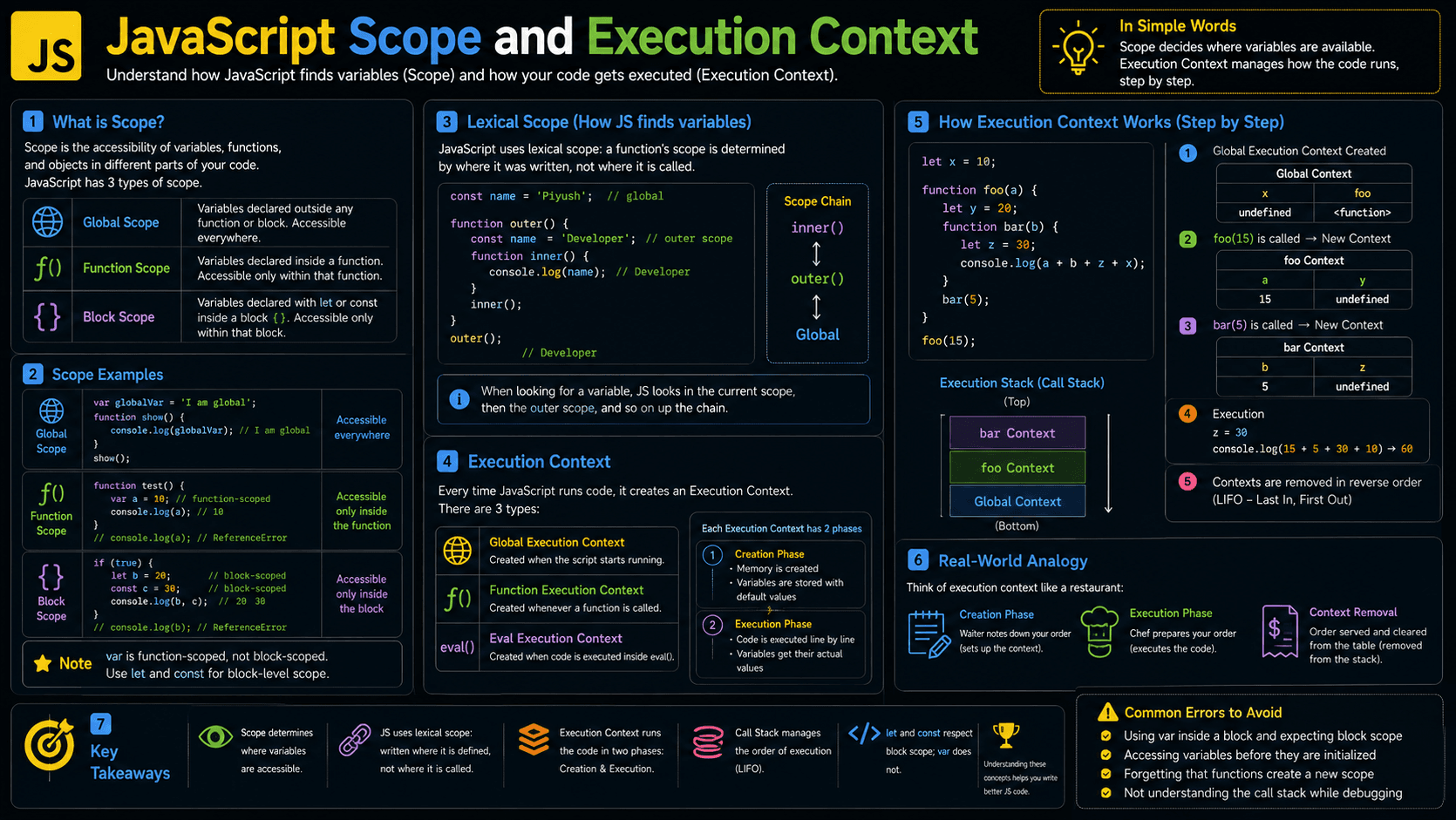
Why can one function reach a variable while another can't touch it? The answer lives in two ideas: JavaScript scope and execution context. Scope decides where a variable is available. Execution context describes the environment JavaScript builds to actually run your code.
Get these two right, and a lot of everyday behavior stops feeling mysterious: function calls, block-level variables, closures, hoisting, callbacks, and the call stack all follow from them.
Here's the idea in three lines:
const appName = "Quiz App"; // global scope

function greet() {
  const user = "Maya"; // function scope — only visible in here
  console.log(appName, user); // Expected output: Quiz App Maya
}

greet();
console.log(user); // ReferenceError: user is not defined
greet can read appName from the outer scope, but user never escapes the function. That single boundary is what the rest of this guide unpacks.
What You'll Learn
- How global, function, block, and module scope differ
- What JavaScript creates when a script or function runs
- How lexical environments and the scope chain resolve variables
- How execution contexts move through the call stack
- Why hoisting, closures, and shadowing behave as they do
- Which scope and execution mistakes commonly cause bugs
Prerequisites for Understanding Scope and Execution
A little comfort with variables and functions goes a long way here. If those feel solid, you'll follow scope and execution context without much friction.
Review these foundations if they are unfamiliar:
You can also test your basics here:
Why Do JavaScript Scope and Execution Context Exist?
Both exist to keep your data organized and your function calls predictable. Without scope, every variable would share one giant namespace. A throwaway variable inside a tiny helper could clobber unrelated application data, and larger programs would turn fragile and painful to debug.
Execution context handles a separate problem. JavaScript has to track which function is running right now, what arguments and local variables it holds, and where to pick back up once it finishes. Without that runtime bookkeeping, you'd be managing function state and return locations by hand.
Put together, they give you isolation and order. Scope limits where names can be used; execution contexts let JavaScript run nested calls safely. That combination is what makes reusable functions, private state, modules, recursion, and closures possible in the first place.
JavaScript Scope and Execution in Plain English
Scope answers one question: "Where is this name available?" Execution answers another: "What code is running now?" The first is mostly fixed by where you write your code. The second shifts constantly as the program runs.
Picture an office building made of rooms. Each room has labeled drawers, and those drawers are your variables. Someone working in an inner room can check the drawers around them first, then walk outward through connected rooms if the label they need isn't there.
That room layout is scope. It's fixed when the building is designed, not when someone walks in.
Now add a clipboard that records every room currently in use. Enter a function room, and a new entry goes on top. Finish the work, and that entry comes off, so work resumes in the previous room.
The rooms are lexical environments. The clipboard is the call stack. Between them, you can explain where JavaScript finds data and how it keeps track of which functions are running.
So scope is about visibility, and execution context is about runtime state. Keep that split in mind and the rest of this guide falls into place.
A Real-Life Analogy for Scope and Execution
Think of a restaurant kitchen. There's a shared pantry everyone uses, but each chef also keeps ingredients at their own station. A chef can grab from their station or the shared pantry, yet nobody can reach into another chef's locked drawer.
Every new order clips a ticket to the kitchen rail. The newest ticket gets handled first, then comes off when it's done. The supplies map to scope; the stack of tickets maps to execution contexts on the call stack.
What Is JavaScript Scope and Execution Context?
JavaScript scope determines where variables and functions can be accessed. An execution context is the runtime environment created when global code or a function executes. It stores bindings, tracks the current code, and connects to outer lexical environments so JavaScript can resolve identifiers through the scope chain.
The distinction comes down to two lines:
- Scope is based on where code is written.
- Execution context is created when code runs.
How Does JavaScript Scope and Execution Work?
JavaScript works in two passes. First it prepares the bindings for a script or function, then it runs the statements. When your code references a variable, the engine checks the current lexical environment and follows outer links until it finds the binding. Each function call spins up a new execution context, which gets pushed onto the call stack and popped off once it's done.
Create the global execution context
JavaScript prepares the environment for top-level code and places the global execution context on the call stack.
Prepare declarations
Function declarations become available, while variable bindings are created according to the rules for var, let, and const.
Execute statements
JavaScript runs the program one statement at a time and assigns values as declarations are reached.
Call a function
A new function execution context is created with its parameters, local bindings, and a connection to its outer scope.
Resolve variable names
The engine searches the current environment first, then follows the scope chain outward.
Return from the function
The function context is popped from the call stack. Reachable data may remain in memory when retained by a closure.
A simplified call stack may look like this:
| calculateTotal() |  <- currently running
| processOrder()   |
| global context   |
+------------------+
Think Like the JavaScript Engine
It helps to trace what the engine juggles behind the scenes: execution contexts, lexical environments, the scope chain, memory, and the call stack.
- The script begins: A global execution context is created and pushed onto the call stack.
- Bindings are prepared: Declarations are registered.
varis initialized withundefined, whileletandconstremain inaccessible until their declarations execute. - A function is called: JavaScript creates a function execution context containing parameters and local bindings.
- A variable is requested: The engine checks the current lexical environment.
- The search moves outward: If the binding is missing, JavaScript follows the outer environment reference. This process forms the scope chain.
- The function returns: Its execution context leaves the stack.
- Memory is reviewed: Data that is no longer reachable can be reclaimed by garbage collection. Data referenced by active closures remains available.
An execution context does not stay on the call stack merely because a closure exists. The context can finish while the closure retains access to the required outer lexical environment.
Core Types of JavaScript Scope
JavaScript has four kinds of scope: global, function, block, and module. Which one applies depends on the declaration keyword you use and where you put the declaration.
| Scope type | Created by | Common declarations | Accessible from |
|---|---|---|---|
| Global scope | Top-level classic script code | var, let, const, functions | Code allowed to access that global environment |
| Function scope | A function body | Parameters, var, let, const | That function and nested scopes |
| Block scope | {} in blocks, loops, and conditions | let, const, class | Only the block and nested scopes |
| Module scope | An ES module file | Top-level module declarations | The module unless explicitly exported |
Lexical Scope and the Scope Chain
JavaScript uses lexical scope. In plain terms, variable access depends on where a function is defined, not where it's called. This trips up a lot of people, so it's worth seeing in code.
const message = "Global message";

function createPrinter() {
  const message = "Printer message";

  return function printMessage() {
    console.log(message);
  };
}

const print = createPrinter();
print(); // Expected output: Printer message
printMessage was created inside createPrinter, so its outer environment is that function's scope. It logs "Printer message" no matter where you eventually call print from. The location of the call never rewires that relationship.
Variable Shadowing
An inner scope can declare a variable with the same name as an outer one. When it does, the inner declaration temporarily hides the outer one. That's called shadowing.
const status = "offline";

function showStatus() {
  const status = "online";
  console.log(status);
}

showStatus();        // Expected output: online
console.log(status); // Expected output: offlineWhen reading nested code, start with the closest declaration and move outward. That is the same direction JavaScript follows when resolving a name.
JavaScript Scope and Execution Examples
The examples below build up gradually, from a plain function scope to runtime state that a closure keeps alive.
Beginner Example: Function and Block Scope
const applicationName = "Quiz App";

function displayUser() {
  const userName = "Maya";

  if (userName) {
    const greeting = `Welcome, ${userName}`;
    console.log(applicationName); // Expected output: Quiz App
    console.log(greeting);        // Expected output: Welcome, Maya
  }

  console.log(userName); // Expected output: Maya
}

displayUser();
displayUser reaches both its own userName and the outer applicationName. But greeting lives only inside the if block, so it disappears the moment that block ends.
Practical Example: Private Counter State
Here's where scope gets genuinely useful. A closure lets a function hold onto its defining scope even after the outer function has returned.
function createAttemptTracker() {
  let attempts = 0;

  return function recordAttempt() {
    attempts += 1;
    return attempts;
  };
}

const recordQuizAttempt = createAttemptTracker();

console.log(recordQuizAttempt()); // Expected output: 1
console.log(recordQuizAttempt()); // Expected output: 2
The createAttemptTracker context finished long ago, yet recordAttempt still points at attempts. That single reference is enough to keep the lexical environment alive, which is why the count survives between calls.
Advanced Example: Call Stack and Recursion
Each recursive call receives a separate execution context.
function factorial(number) {
  if (number <= 1) {
    return 1;
  }

  return number * factorial(number - 1);
}

console.log(factorial(4)); // Expected output: 24
At its deepest, the stack holds contexts for factorial(4), factorial(3), factorial(2), and factorial(1) all at once. Then they unwind in reverse order, each one multiplying its result on the way out.
How to Recognize Scope and Execution in Real Code
Once you know what to watch for, you'll spot scope and execution everywhere code declares variables, creates functions, or nests calls. The telltale signs are {} blocks, function declarations, arrow functions, let, const, var, imports, and callbacks.
Common production patterns include:
- Functions returning other functions
- Event handlers reading surrounding variables
- React components and Hooks using values from a render
- Factory functions that preserve private state
- ES modules exposing selected values through
export - Recursive functions creating repeated stack frames
- Timers and promise callbacks executing after surrounding code finishes
- Debugger panels showing local, closure, module, and global scopes
A quick test: if a value's availability depends on where it was declared, you're looking at scope. If the question is which function runs first or returns next, you're looking at execution context and the call stack.
Common Scope and Execution Mistakes
Most scope bugs trace back to three habits: assuming JavaScript uses call-site scope, overlooking block boundaries, or misreading when a declaration is actually initialized. Here's each one in action.
Mistake 1: Accessing a Block-Scoped Variable Too Early
Temporal dead zone: A let or const binding exists from the start of its scope but cannot be accessed before its declaration executes.
❌ Wrong
console.log(score); // ReferenceError
let score = 10;
✅ Correct
let score = 10;
console.log(score); // Expected output: 10
Mistake 2: Expecting Scope to Depend on the Caller
❌ Wrong assumption
const topic = "Global";

function showTopic() {
  console.log(topic);
}

function runLesson() {
  const topic = "Functions";
  showTopic();
}

runLesson(); // Expected output: Global
showTopic reads from the scope where it was defined, not the scope it was called from. So it sees the global topic, not the one inside runLesson.
✅ Correct when a caller should supply the value
function showTopic(topic) {
  console.log(topic);
}

function runLesson() {
  const topic = "Functions";
  showTopic(topic);
}

runLesson(); // Expected output: Functions
Mistake 3: Using var in Asynchronous Loops
var creates one function-scoped binding for the loop. Every callback can observe the same final value.
for (var index = 0; index < 3; index += 1) {
  setTimeout(() => {
    console.log(index);
  }, 0);
}

// Expected output: 3, 3, 3
The fix is let. Each iteration gets its own fresh binding, so every callback closes over the value it saw at that moment instead of the shared final one.
Best Practices for Predictable Scope
A few habits keep scope predictable and cut down on accidental state changes. Clear declaration boundaries do most of the heavy lifting.
Prefer const by default. Use let when reassignment is required, and avoid var in modern application code unless you specifically need its function-scoped behavior.
- Keep variables in the smallest useful scope.
- Pass values as arguments when a dependency should be explicit.
- Avoid reusing the same name across several nested scopes.
- Keep functions focused to reduce the number of active bindings.
- Use ES modules instead of placing application state in global scope.
- Inspect the call stack and scope panels when debugging.
- Remove unused event listeners when their closures retain large objects.
A closure retaining data is not automatically a memory leak. It becomes a problem when an unnecessary long-lived reference prevents unused data from being garbage-collected.
Scope Versus Execution Context
These two terms get used almost interchangeably, but they describe different parts of how JavaScript behaves. This table lines them up side by side.
| Question | Scope | Execution context |
|---|---|---|
| What does it control? | Variable visibility | Runtime function state |
| When is it determined? | Primarily from code structure | When code begins executing |
| What connects nested levels? | Scope chain | Call stack |
| Does every function call create one? | No new lexical definition | Yes, a new function context |
| Can a function retain related data? | Yes, through closure | The finished context leaves the stack |
Real-World Uses of Scope and Execution Context
You lean on these mechanisms in real projects all the time, even when nobody names them out loud.
- Modules: Keep internal helpers private and export only a public API.
- Event handlers: Access surrounding component or page state.
- React functions: Create closures over props and state during each render.
- Authentication middleware: Store request-specific values in local execution paths.
- Factory functions: Create independent objects with private state.
- Memoization: Retain cached results between function calls.
- Recursion: Track each call's arguments and return position.
- Async callbacks: Preserve required values until a timer, promise, or event runs.
JavaScript Scope and Execution Interview Questions
Interviewers use questions like these to see whether you can connect code structure with what happens at runtime.
Frequently Asked Questions About Scope and Execution
Short answers to the questions that come up most often about scope, execution contexts, and variable lookup.
Related JavaScript Topics and Quizzes
Keep the momentum going with a closely related concept, or put what you've learned to the test.
🔑 Key Takeaways
- Scope controls where variables and functions can be accessed.
- Execution contexts track global code and active function calls at runtime.
- JavaScript resolves names from the current lexical environment outward.
letandconstare block-scoped, whilevaris function-scoped.- Every function call adds a new execution context to the call stack.
- Closures can preserve access to outer bindings after a function returns.
Test Your JavaScript Scope Knowledge
Can you predict variable lookup, closure output, and call-stack order without running the code?
👉 Test your knowledge with our JavaScript Scope and Execution Quiz